

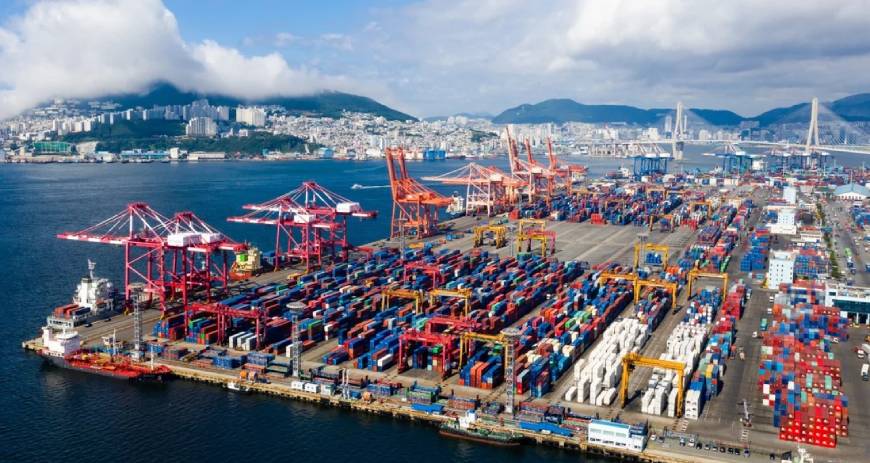
Predictive AI for global synchronisation: the Busan port model
Korean digitalisation leads the way towards zero waiting times in freight transport through deep learning architectures
Palma
27/02/2026- Otros
The Port Authority of the Balearic Islands (APB) Innovation Department brings you the latest trends in port innovation. Our focus is on implementing state-of-the-art Artificial Intelligence architectures following the validated results at the port of Busan, where the use of predictive models has enabled operational efficiencies estimated at millions of euros per year and a 15% reduction in fuel consumption by approaching ships.
This logistics hub, ranked sixth largest in the world, has integrated deep learning neural networks, specifically ConvLSTM (Convolutional Long Short-Term Memory) architectures, capable of processing massive flows of geospatial and temporal data in real time. This system not only calculates the estimated time of arrival with a margin of error of less than ten minutes, but is also capable of dynamically simulating the behaviour of the entire dock in adverse weather conditions or unexpected peaks in demand, allowing for ‘just-in-time’ berth allocation that minimises unnecessary anchoring.
The Busan model is positioned as a benchmark for logistical sovereignty by transforming the port into a smart platform where interoperability between ships, terminals and land transport is total under the sub-GHz communication standard and private 5G networks. Technology monitoring confirms that this approach allows port managers to perform ‘asset orchestration’ in which gantry cranes, transfer vehicles (AGVs) and external trucks operate in a sequence choreographed by combinatorial optimisation algorithms. The adoption of these advanced analytics standards not only improves punctuality and nautical safety through early detection of collision risks, but also offers complete cargo traceability through blockchain.
The innovation platform has identified this advance as a critical differentiating factor in attracting new trade routes in a global market that, by 2026, will no longer compete solely on draught or surface area, but on the ability to process data to reduce uncertainty and the carbon footprint of each container movement.